
Unearthed Stories: The Secrets of Ancient Scrolls Near Pompeii
Chris T.
Picture this: you’re holding an ancient scroll that’s survived nearly 2,000 years… and you still can’t read it because the second you try to unroll it, it basically turns into dust.
That’s not a dramatic “movie archaeologist” exaggeration. It’s the actual headache researchers face with some of the world’s most valuable ancient texts—especially the ones that got roasted, crushed, or sealed in time by disaster.
Why some ancient scrolls are still unreadable
Let’s be honest: we all assume ancient documents are either “found and translated” or “lost forever.” The frustrating middle category is this:
They exist. We can see them. We can even scan them. But opening them would destroy them.
Some scrolls are so fragile that even careful handling breaks them apart. Others are burned into carbon-like lumps where ink and papyrus blend together in a way your eyes just can’t separate.
Key insight
The biggest breakthroughs aren’t coming from “carefully unrolling” scrolls anymore. They’re coming from scanning them and using software to read the writing without physically touching the scroll at all.
The wild solution: “Virtual unrolling”
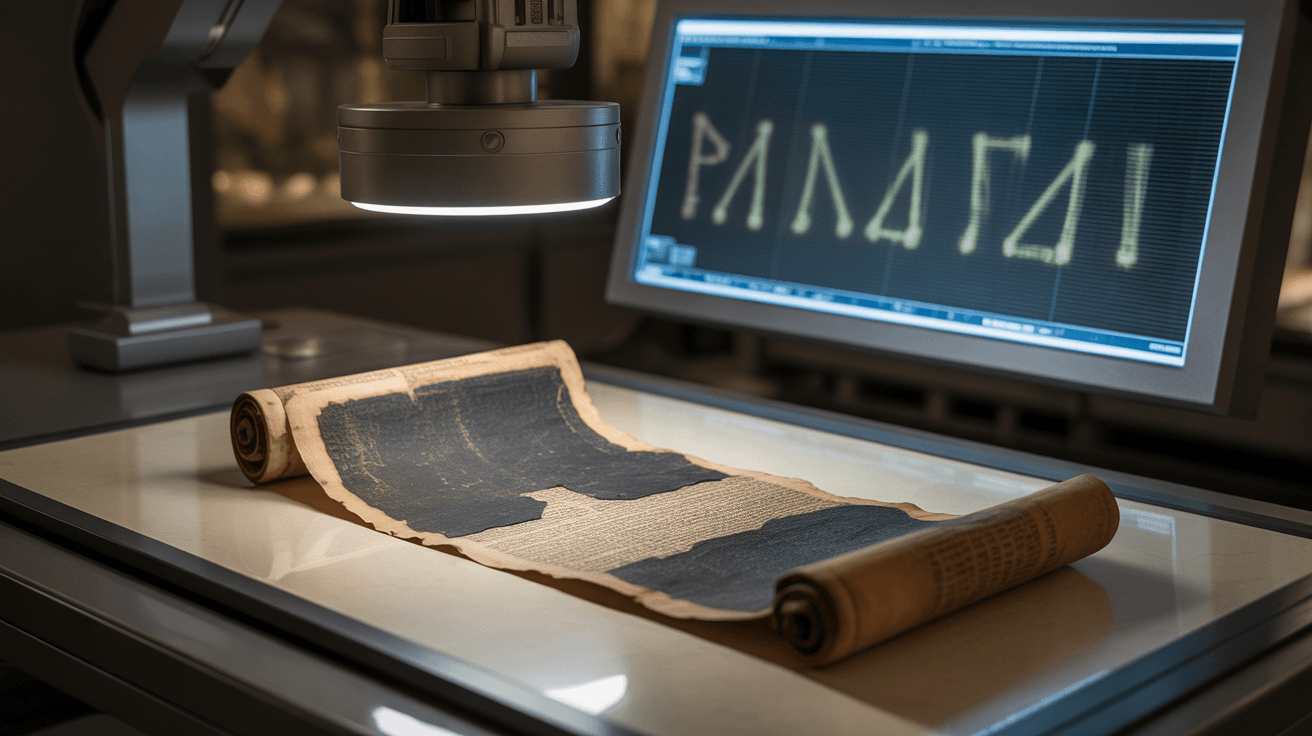
Instead of opening fragile scrolls by hand, researchers use advanced imaging to scan the layers inside, then reconstruct the text digitally. It’s basically like doing surgery with light and math.
This technique is often connected to the scrolls found in places like Herculaneum, a Roman town that was buried in the eruption of Mount Vesuvius. Many of these scrolls are carbonized—meaning they survived, but in the worst possible “how do we read this?” form.
If you want a quick background on why the Vesuvius eruption is such a big historical deal, Britannica’s overview of the AD 79 eruption lays it out clearly.
How do you read ink that you can’t see?
Here’s the part people miss: it’s not just about scanning. It’s about spotting the difference between ink and the material it’s written on.
And when everything is basically charcoal-black, that difference can be tiny. So researchers lean on imaging techniques and AI-style pattern recognition to tease out letters that are otherwise invisible.
A good example of the tech behind this kind of work is Nature’s reporting on efforts to read the Herculaneum scrolls, which explains why this is so hard—and why it’s finally starting to work.
What secrets could these scrolls actually contain?
This is where the story goes from “cool tech” to “wait, this could change history.” Because we’re not talking about random shopping lists. Some of these scrolls may contain:
- Lost philosophy from schools of thought we only know through secondhand quotes
- Everyday Roman life details historians would kill for (politics, gossip, money, habits)
- Unknown literature that simply didn’t survive in any other form
- Early science ideas that show what people thought they understood about the world
In other words: this isn’t about “reading old stuff for fun.” It’s about possibly recovering entire voices we’ve never heard directly.
The practical part: why this matters outside of museums
I know, I know—ancient scrolls sound like a niche obsession. But the tech being developed here has a bigger ripple effect.
Non-invasive scanning and digital reconstruction isn’t only useful for Roman scrolls. The same logic applies to:
- fragile manuscripts that can’t be handled
- damaged historical documents (smoke, water, age)
- sealed letters and folded texts that museums don’t want to open
- archaeological finds where touching = destroying
Real-world takeaway
Virtual unrolling is basically “digital conservation.” It lets researchers extract information while leaving the original artifact intact—which is exactly how modern preservation is supposed to work.
What most people get wrong about “ancient secrets”
When you hear “ancient scrolls,” it’s tempting to imagine forbidden spells, maps to hidden treasure, or some dramatic lost prophecy.
But the truly valuable stuff is usually quieter:
- What people believed (and how they argued about it)
- How they lived when they weren’t doing “history-book moments”
- How ideas traveled across cultures and empires
That’s the real treasure: context. The kind that makes the ancient world feel less like a statue and more like a living place full of opinions, fights, and everyday routines.
FAQ
What are the Herculaneum scrolls?
They’re ancient Roman papyrus scrolls discovered in Herculaneum, many of which were carbonized by the eruption of Mount Vesuvius in AD 79.
Why can’t researchers just unroll ancient scrolls normally?
Many are too fragile or burned, meaning unrolling them by hand would destroy the text and the artifact itself.
What does “virtual unrolling” mean?
It’s a technique where scientists scan scrolls and digitally reconstruct the layers to reveal writing without physically opening them.
Are these scrolls likely to contain “hidden secrets”?
Some could contain lost philosophical works, literature, or details about everyday Roman life—less “mystical,” more historically huge.
Is AI being used to read these scrolls?
In some projects, yes. Machine-learning methods help detect faint ink patterns in scans and make the text readable.
Key Takeaways
- Some ancient scrolls can’t be physically unrolled without destroying them.
- Researchers now use “virtual unrolling” to read texts non-invasively.
- Carbonized scrolls (like those from Herculaneum) are the hardest—but most exciting—to decode.
- The real value is recovering lost philosophy, literature, and everyday history.
- This tech also helps preserve other fragile manuscripts and sealed documents.
- “Ancient secrets” usually means context and forgotten voices, not treasure maps.
 Social Media Buzz
 Decoding 'Brat Green' and Other TikTok Fashion Trends: Their Impact and Influence
Written by: Zoe M. Social Media Correspondent I follow the stories that ...
 Weird & Bizarre
 The Unusual Collapse of New York's Legendary Wine Emporium, Sherry-Lehmann
Written by: Chris T. Weird & Bizarre Editor I chase the kind of stories ...